Union Education Secretary for introducing heritage education in school curricula
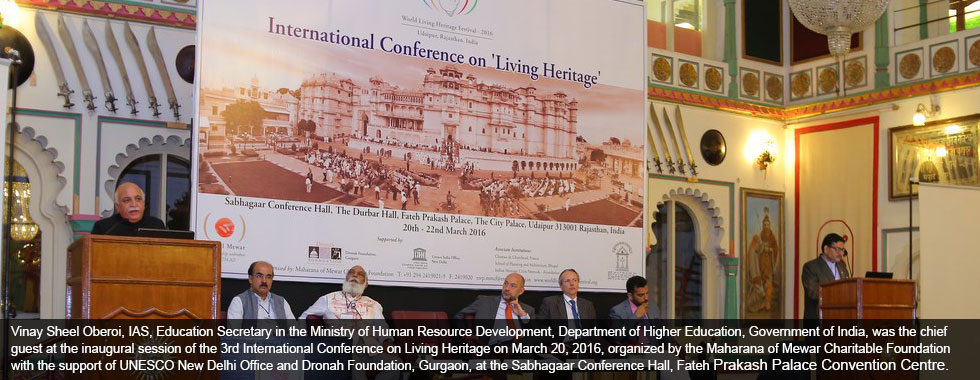
At the inaugural session of 3rd International Conference on Living Heritage in Udaipur, Vinay Sheel Oberoi, Education Secretary, Government of India suggested to introduce heritage education in school curricula.
“The government needs to introduce heritage education in school curricula,” said Vinay Sheel Oberoi, IAS, Education Secretary in the Ministry of Human Resource Development, Department of Higher Education, Government of India. He was the Chief Guest at the inaugural session of the 3rd International Conference on Living Heritage, organised by the Maharana of Mewar Charitable Foundation with the support of UNESCO New Delhi Office and Dronah Foundation, Gurgaon, at the Sabhagaar Conference Hall, Fateh Prakash Palace Convention Centre. Oberoi added that, “Living heritage is linking our past with the present and has the power to shape the future.” He also appreciated the work on heritage preservation at Udaipur’s City Palace Museum.
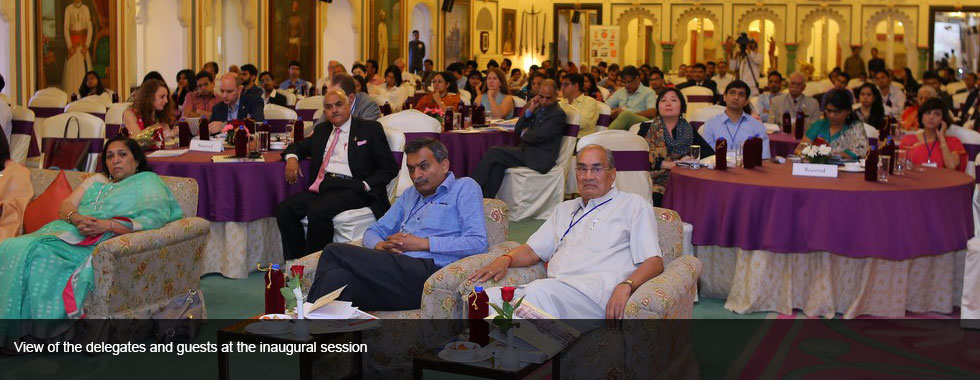
The inaugural session of the conference witnessed the participation of His Excellency The Ambassador of France to India, Francois Richier, Jean d’Haussonvile the General Manager of Domaine national de Chambord, Sabhyasachi Mukherjee, Director General and Secretary, Chhatrapati Shivaji Maharaj Vastu Sangrahalaya, Mumbai, Shriji Arvind Singh Mewar, Chairman and Managing Trustee of the Maharana of Mewar Charitable Foundation and Lakshyaraj Singh Mewar, Trustee of the Maharana of Mewar Charitable Foundation.
The Ambassador of France to India, Francois Richier highlighted the numerous projects being undertaken by the French Embassy to help preserve heritage across India. “We will bring senior conservation architects from France to help the heritage preservation projects in Lucknow, Pondicherry,” he said. The Ambassador was satisfied with the progress on the partnership agreement between Domaine national de Chambord in France and the Maharana of Mewar Charitable Foundation, Udaipur.
Jean d’Haussonvile, the General Manager of Domaine national de Chambord, said in his address that “Chambord and City Palace, Udaipur have many common characteristics and features. Both were established in the 16th century and have demonstrated perpetual renewal.” Chambord is regarded as the ‘Mona Lisa of architecture’ and a shining example of Renaissance genius. “Just as the City Palace of Udaipur works for sustainable development, Chambord too believes in these modern practices to preserve its heritage,” he added. Sabhyasachi Mukherjee, Director General and Secretary, Chhatrapati Shivaji Maharaj Vastu Sangrahalaya, Mumbai delivered the keynote address. “Even after eight decades of Independence in India, we have not been able to give our ‘culture’ its due importance and priority,” he said, adding “Our identities are based on our culture but the budgetary allocations of the government for culture and cultural institutions are miniscule.”
In his welcome address, Shriji Arvind Singh Mewar, Chairman and Managing Trustee of the Maharana of Mewar Charitable Foundation, thanked the dignitaries for being in Udaipur and acknowledging the power of ‘living heritage’ to unite people and nations together.



You might also like

DGCA may ground 130 Air India pilots for skipping mandatory alcohol test
DGCA rules say all pilots and cabin crew must undergo breath-analyser test before and after flights. India’s aviation regulator DGCA has found 132 pilots and 434 cabin crew of state-owned Air

Pakistan’s link unearthed in Kanpur train accident that killed more than 140 passengers, 3 arrested
According to sources, ISI plotted the Kanpur train derailment on November 20, 2016 in which over 140 people were killed. Railways has rushed an investigation team to Motihari in East
Three years of the Modi Government: many positives but few transformational changes
In its three years in power, the Modi Government has taken many positive steps for the development of tourism in the country, but few in the travel & tourism industry