

Study finds 80 percent of travel managers today make mobility the biggest priority in corporate travel
Sabre Asia Pacific Corporate Traveller study released today reveals:
- Almost half of all corporate travellers make changes to their trips
- Rise of mobile and virtual payment technologies
- Premium economy – A new corporate favourite
Sabre Corporation today unveiled findings from its 2017 Asia Pacific Corporate Traveller study. One key finding shows that 80 percent of travel managers now believe mobility to be the biggest priority in managing corporate travel; another underscore the rise of premium economy as a new corporate favourite class; a third finds companies trying to stay on top of corporate travellers who are increasingly deviating from their travel policy.
“The increasing incidence of non-compliance is the result of corporate travellers booking out of policy, where they extend business trips to include some leisure time at their own expense. With more companies shifting accountability of policy compliance to the traveller, the ability to integrate non-traditional sources of flight and accommodation, and option to change plans easily while on the go, will go a long way in helping the corporate traveller adhere to policy without compromising on the quality of travel,” said Jason Toothman, vice president of global accounts, Sabre Travel Network Asia Pacific.
Almost half of all corporate travellers make changes to their trips
According to the study conducted on corporate travel professionals from across 19 countries in the region, more than 43 percent of corporate travellers are deviating from company policy ahead of the trip and 42 percent are making changes while travelling. As companies strive to find the balance between driving compliance and increasing their corporate travellers’ satisfaction, respondents have seen corporations actively re-crafting their travel policies (32 percent in 2015 vs 47 percent in 2016) to accommodate more booking autonomy. One quarter of respondents also noted that most of their clients have deployed mobile app(s) that incorporate policy compliance options, shifting accountability of compliance to the traveller.
Rise of mobile and virtual payment technologies
When asked what it is they considered to be the biggest priority in managing corporate travel in their organisation, 80 percent of travel managers believe mobility – from making a booking through a mobile device, to itinerary management, to staying in touch with their traveller via instant messaging – is their top priority, highlighting the importance placed on moving towards a mobile first strategy. 66 percent also quoted looking at alternative forms of payment technology as a high priority area for them.
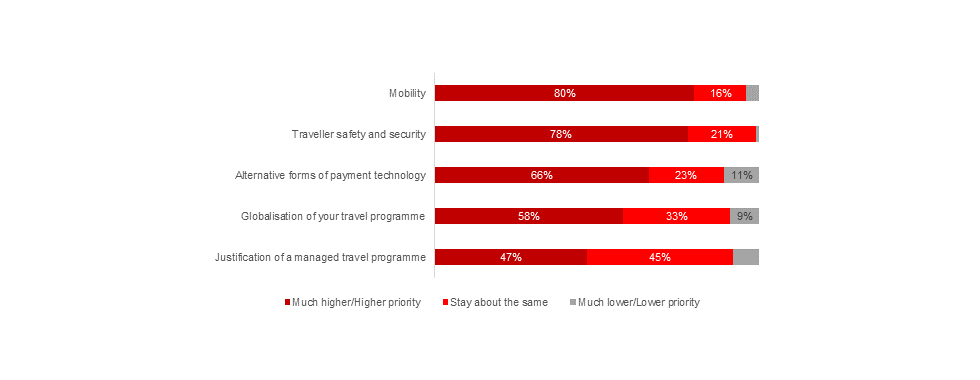
Today, new technologies are emerging at a rapid pace, ultimately opening up countless new revenue channels for travel companies to tap into. Travel managers have an opportunity to engage their corporate travellers on multiple devices at all points of the journey for a truly seamless trip. Product solutions that can seamlessly integrate booking, itinerary management, messaging, virtual payments, expenses reporting and travel risk management will help corporate travellers improve their traveller experience, whilst helping their organisations maximise efficiency, streamline expenses and improve compliance.
Premium Economy – A new corporate favourite
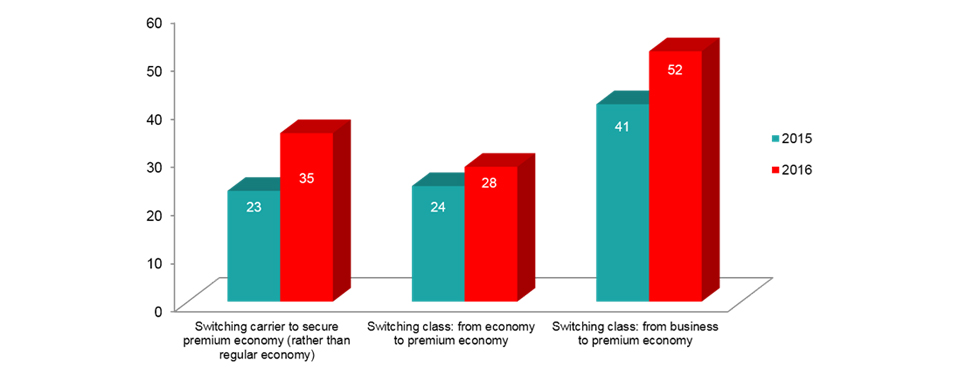
Amidst economic uncertainty, companies are cutting back on premium class air travel and as such, premium economy options have become the next best alternative without significantly impacting travellers’ comfort. From the report, over half of the respondents indicated that companies are switching class from business to premium economy. On the other hand, some businesses are upgrading travellers from economy to premium economy for higher traveller satisfaction. Both forces have contributed to 81 percent of respondents are seeing an increase in premium economy bookings.
The Sabre Asia Pacific Travel Study surveyed corporate travel professionals from 19 key markets across the region, representing corporate travel management companies and travel agencies servicing corporate accounts. Countries covered included Afghanistan, Australia, Bangladesh, Brunei, Cambodia, China, Hong Kong, India, Japan, Malaysia, Nepal, New Zealand, Pakistan, Philippines, Singapore, South Korea, Sri Lanka, Taiwan and Thailand.



You might also like
50% of US-bound Indian flyers to be impacted by US govt curbs on e-devices
Over 1.3 million, or 49% of passengers flew to the US via airports in the Gulf in FY16. Washington DC’s decision to impose curbs on taking iPads and laptops as

Turkey Visa Application Centre inaugurated in Mumbai, India
Centre in Mumbai is among the 18 Turkey Visa Application Centres being rolled out across India, the Maldives and Nepal The VFS Global Turkey Visa Application Centre in Mumbai was
Virgin Atlantic launches freedom sale
Virgin Atlantic launches Freedom Sale offering 30% off to commemorate India’s 72nd Independence Day Virgin Atlantic is celebrating India’s 72nd Independence Day by offering its customers incredible savings through a freedom