
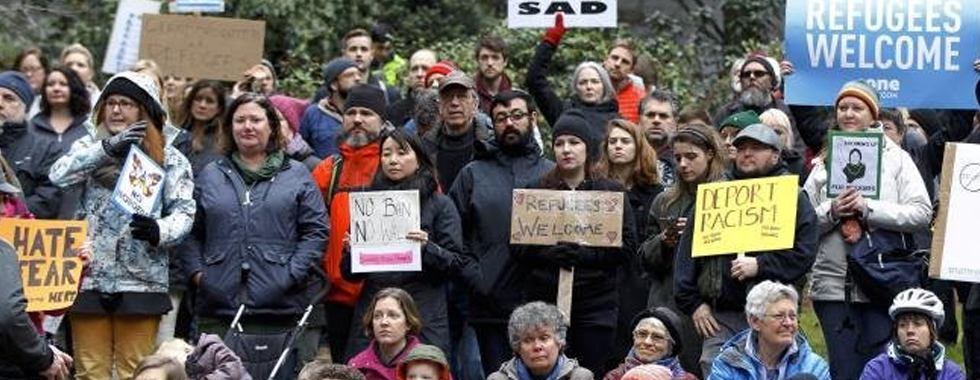
Indian-origin US academics denounce Trump’s travel ban
A section of Indian-origin researchers based in the US, who have joined 51 Nobel laureates and over 27,000 academics from across the globe in denouncing President Donald Trump’s travel ban, have warned against such prohibitions extending to any group of people.
On January 27, Trump signed an executive order banning citizens from seven Muslim-majority countries for 90 days, suspending all refugee entry to the US for 120 days, and indefinitely barring entry for Syrian refugees.
In response, over 20,000 faculty members from many of the most prestigious universities across the US, as many as 572 members of the US National Academy of Sciences and hundreds of award winning scientists, signed the “NoToImmigrationBan” petition, opposing the order, apprehending “the unrealistic conditions required for discontinuing the suspension make it very likely that it will turn into a permanent ban”.
Dubbing it the “worst form of superstition that we have seen in recent times”, veteran anthropologist Veena Das urged everyone to join against the ban.
“Scientists and scholars in India should also rally against the slow corrosion of intellectual autonomy that has been happening in India, perhaps slowly, but surely,” Das, Krieger-Eisenhower Professor of Anthropology at the Johns Hopkins University, told IANS via email.
“Responsibility toward knowledge is not a national enterprise but one that will either nourish or corrode the human spirit. It is up to us to crush the rising tide of stupidity,” she said.
Massachusetts Institute of Technology’s (MIT) computer science and engineering professor Arvind, who has “outstanding colleagues and students” from Syria, Iran, Palestine, Egypt, Pakistan and India, many of whom are Muslims, questioned the justification of the order.
“It is a ban on Muslims only because Christians are explicitly excluded. Should all Muslims pay the heavy price of dashed dreams because of a few Muslim terrorists?”
“Indians should realise that such arbitrary bans can be extended easily to any group of people, for example, Indian Muslims or even all brown skinned people,” Arvind, Johnson Professor of Computer Science and Engineering at MIT, told IANS in an email.
Apart from academics signing the petition, as many as 171 leading scientific, engineering and academic organisations in the US have called on Trump to rescind the executive order declaring it damaging to scientific progress, innovation and US science and engineering capacity.
Das, who says one reason for the dominance of US universities in the generation and dissemination of knowledge, was the “historical openness to scholars and scientists from other countries”, believes universities will suffer enormously in tangible and intangible ways, in the age of networking.
“There is the larger question that looms on the horizon, which is that if policy is going to become so divorced from any facts on the ground, how will rational governance be possible,” she questioned.
As an anthropologist, Das iterated concerns of the community, primary of which veers on the thought that as borders close down, there will be less people ready to go and do fieldwork in areas of the world that require “diligent attention” to know what is happening on the ground.
Arvind opined that the MIT (known for its diversity in faculty and students) and by implication the US, would lose its pre-eminence in science and technology if doors were closed to the scholars from any part of the world.
News Source: IANS



You might also like
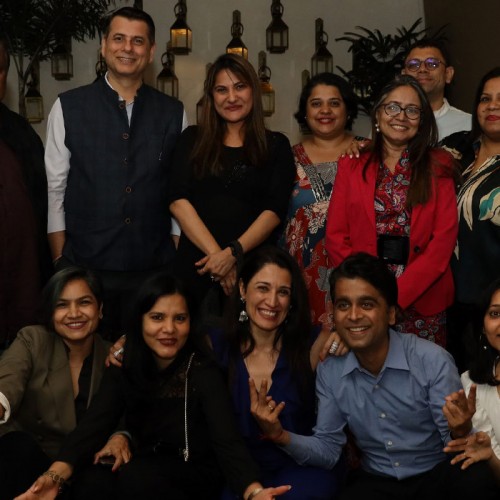
Sarova Hotels & Resorts Kenya Celebrates a Strong 2025, Sets Sights on Deeper India Engagement in 2026
Sarova Hotels & Resorts Kenya marked 2025 as another successful year with significant growth driven by strong collaboration with the Indian travel trade across the FIT, MICE, group travel segment.

Aviation varsity to launch industry programme
Rajiv Gandhi National Aviation University in collaboration with US-India Aviation Cooperation Programme is set to launch its first executive development programme from next month. The first such two-day programme, to
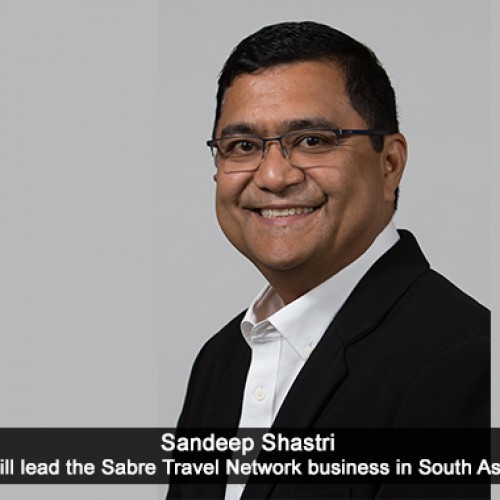
Sabre appoints Sandeep Shastri to lead Travel Network Business in South Asia
Sabre Corporation announced the appointment of Sandeep Shastri as the new regional director, South Asia, within the Travel Network team in Asia Pacific (APAC). In this role, Shastri will lead