
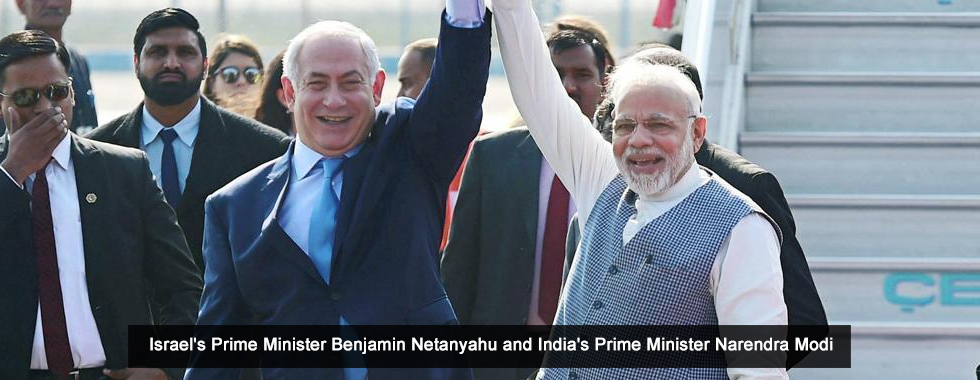
India-Israel sign bilateral agreements on energy, cyber security
On Day 2 of his maiden visit to India, second by any Israeli Prime Minister, Benjamin Netanyahu held delegation-level talks with Prime Minister Narendra Modi. PM Modi invited Israeli defence companies to take advantage of the liberalized FDI regime to make more in India with Indian companies. The two countries also inked 9 MoUs in areas like oil and gas, air transport, space, etc.
In the joint statement, the two leaders also expressed desire to scale up the existing Centers of Excellence in India which have been a main-stay of agricultural cooperation between the two countries by bringing in advanced Israeli practices and technology. We are venturing into less explored areas of cooperation, such as oil and gas, cyber security, films, and start-ups, PM Modi said in his address.
Israeli PM Benjamin Netanyahu’s six-day visit to India is a historic occasion because he is only the second Israeli leader to come to India since Ariel Sharon’s 2003 trip. Netanyahu is accompanied by a 130-member delegation comprising of individuals from agriculture, cyber and defence sectors.
Earlier, in an exclusive conversation with Raj Chengappa, India Today’s Group Editorial Director (Publishing), the Israeli premier talked optimistically about an Indo-Israel partnership, saying that it is “a marriage made in heaven but consecrated here on earth”. Among the things he hopes to concentrate on during this visit is cooperation in technological areas, especially agriculture. “Can you imagine drones for agriculture? That is what Israel can do for the Indian farm,” said Netanyahu, explaining how the big data and photographs of fields collected by drones can help farmers to “direct the water to the level of the individual plant”. This will, thus, help India produce more crops for less-less water, less energy. “This is using technology to change not only the future, but to change lives today to make people healthier, safer, better nursed and to live longer, better lives. This is one area I intend to concentrate on but there are many others,” he added.
When asked his opinion for taking Indo-Israel relations beyond diamonds and defence, Netanyahu had a short, candid answer: Free trade agreements. Or at least, moving in that direction, as he put it. To illustrate his point, Netanyahu gave the example of the auto industry. “India has a very well-known auto industry,” he said but pointed out that though Israel’s auto industry was just five years old, it was already turning out to be a leader in the field. “We have 500 start-ups that just deal with automotive technology or autonomous vehicles. Because [going forward] 85% of a car is going to be software and just 15% will be hardware,” he explained. In other words, cars of the future will be “basically a computer on wheels”, and this is where Israel is a pioneer. “Our car industry receives billions of dollars of investments every year. Why shouldn’t we have the same partnership between us and Indian car manufacturers? And this can happen everywhere, be it digital health, water, energy, transportation, IT… And all this is before you discuss security,” said Netanyahu.
News Source: www.businesstoday.in



You might also like
Indian passport to get a makeover
India has decided to do away with the last page of the passport that contains the names of the spouse, parents and address of the passport-holder while changing the colour

Taiwan Bets on India: Inside TAITRA’s Push for Deeper Trade and Tech Collaborations
As bilateral trade crosses $10 billion, TAITRA is catalyzing cross-border collaborations through focused outreach and industry-specific platforms. As India strengthens its position in global manufacturing and supply chains, Taiwan has

Gradual opening continues but are travellers ready to travel?
Even as the overall number of Covid-19 cases continues to rise in the world, in some countries like India, the number is increasing more rapidly, nations are relaxing restrictions and